
Gray County Booking Photo Records
A booking photograph is an image made as part of a jail intake. Gray County's public channels demand more care because the Sheriff operates a processing point and may send a person to an outside jail. The Gray County Sheriff may hold an arrest or processing image, while Ford or Meade County may hold the actual jail booking photograph. An image can remain in an agency file after physical custody ends.
Kansas Open Records Act definitions in K.S.A. 45-217 exclude jail rosters from the definition of criminal-investigation records. That distinction helps separate a roster entry from an investigative file. It does not guarantee disclosure of every photograph or personal field. The custodian applies KORA and may cite another provision for withheld material.
A photo is not a guilt finding. Arrest, citation, booking, release, case disposition, and sentence discharge are distinct events. Keep the source agency, image label, and publication or capture date with the image, then verify release through the appropriate custody record.
Gray County Released Photo Channels
No one source is complete. Choose a channel from the custodian that handled the event. Gray arrest posts can document a local incident, while a host jail may have the intake image. KDOC records concern state custody, and federal agencies follow different publication rules.
| Official channel | Photo availability | What to do |
|---|---|---|
| Gray Sheriff CRIMEWATCH | Selected posts show a “Photo” | Read the narrative and image label; verify whether booking occurred. |
| Gray records request | May include a releasable processing image | Request the named event, image, and release or transfer fields. |
| Ford or Meade jail | May hold the host-jail booking photo | Confirm the destination, then request the intake and release record there. |
| KDOC offender record | May display a state offender photo | Treat it as a state corrections image, not a Gray booking photo. |
| KBI registry | Qualifying records may have an image | Use only for the limited statutory registry population. |
| Federal agencies | BOP locator has no general mugshot gallery; USMS restricts photos | Use case-specific official releases and federal records routes. |
VINELink is useful for county-jail custody changes, but it should not be treated as a permanent photo archive. The release event belongs in VINE or the jail record. The image itself needs its own source and label.
Gray Sheriff App Photo Limits
The official Gray County sites reviewed do not publish a jail roster or rolling recent-release list. The Gray Sheriff CRIMEWATCH portal offers an app, agency follows, arrests, news, and alerts. Those features surface selected agency posts. They do not create a full jail database or a 24-hour release list.
CRIMEWATCH cards and full posts may show a subject image beside charges, descriptors, a narrative, arrest date, reference ID, and created or updated dates. The interface calls the image a “Photo of [name].” It does not expressly label the image as a jail booking photograph. A post may also be created well after the arrest. Publication time is not a release time.
The official CRIMEWATCH app and follow screen shows the mobile and social layer available for Gray County.
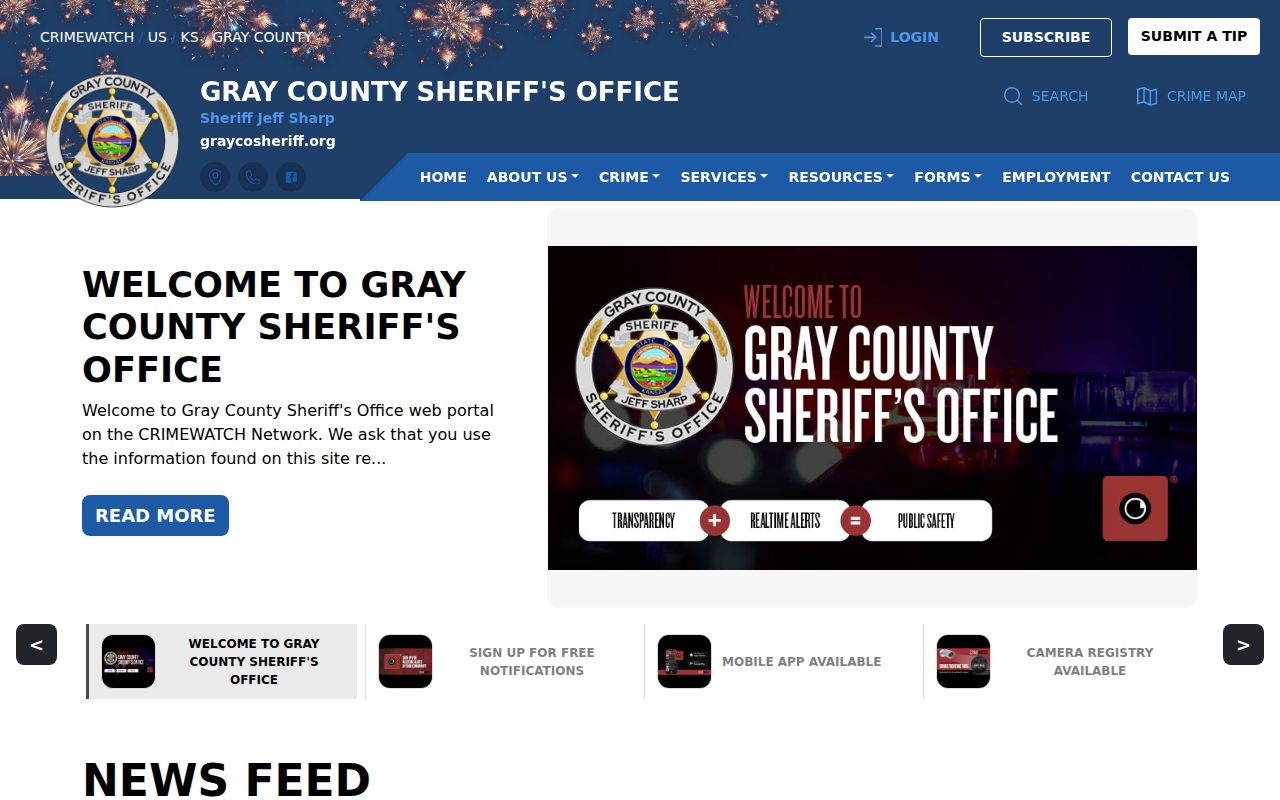
The screen supports following agency posts and alerts, but it does not turn those selected posts into a complete release or booking-photo archive.
Request Gray County Booking Photos
When an online image is absent, send a focused written request to Gray County Sheriff's Office Records at gysorecords@grayco.org or PO Box 487, Cimarron, KS 67835. Ask for the booking or processing photograph tied to a named event and date range. Request the release or transfer entry separately, since the photo alone cannot show the custody outcome.
- Identify the person, approximate arrest or processing date, and Gray agency reference number if known.
- Ask for the releasable booking or processing photograph and state the desired file format.
- Also ask for booking, release, transfer, host-facility, and release-type fields.
- If Gray identifies Ford or Meade as the jail, send that jail a second request for its intake image and release entry.
- Ask for a cost estimate before copies. No current Sheriff photo price list was located.
- If any part is withheld, request the legal basis and the name of the agency holding the omitted record.
The Gray County open-records process says a written form may be required, fees may be charged, and most records will be produced within three business days. A denial should come with a written explanation. The county clerk can explain local procedure, but the Sheriff or host jail remains the proper custodian for its own image.
Gray Release Images Beyond Jail
KDOC may display a photograph in a state offender record. That photo identifies a person in state corrections and may remain visible after prison release. It is not necessarily the Gray County image and does not prove a specific local booking. A qualifying sex, violent, or drug offender may also appear in the KBI Registered Offender Website. That image is a registry image for a limited statutory group, not a complete list of people released in Gray County.
Agency news and press releases can preserve an image after a live entry disappears. Coverage is selective. Record the caption, source agency, and publication date, because the image may be an older file photo or supplied by another office. No news result does not show that no booking occurred.
Commercial aggregators can retain stale or mislabeled images and are neither linked nor endorsed here. When one supplies a lead, return to the named agency, jail, court, or KDOC record for confirmation. Never allow an old image to stand in for the current case or custody status.
Gray Mugshots After Expungement
Kansas expungement can change public court access and the legal treatment of a record. It should not be described as erasing every historic image from every system. Agency files, court files, jail records, state corrections records, registries, and independent publications can be subject to different retention and disclosure rules. A certified expungement order should be sent to the office maintaining an inaccurate display with a request for its correction procedure.
No Kansas-specific mugshot-publication or anti-pay-to-remove statute was located in the official sources reviewed for this project. That is a bounded finding, not a promise that no other remedy can apply. Do not borrow another state's takedown deadline or promise that a private publisher must remove an image. KORA governs access to government records; it does not itself create a general removal process for outside publishers.
When a Gray Photo Is Not a Mugshot
Gray's official arrest posts show why labels matter. Some put a subject image next to the charge and event narrative, but the platform labels the image as a “Photo.” One documented person was cited and released, which may occur without admission to Ford or Meade County Jail. Another was processed by the Gray Sheriff and posted bond. A third was transported to Ford County Jail and remained in custody.
The official cited-and-released post demonstrates the image label and the later publication metadata.
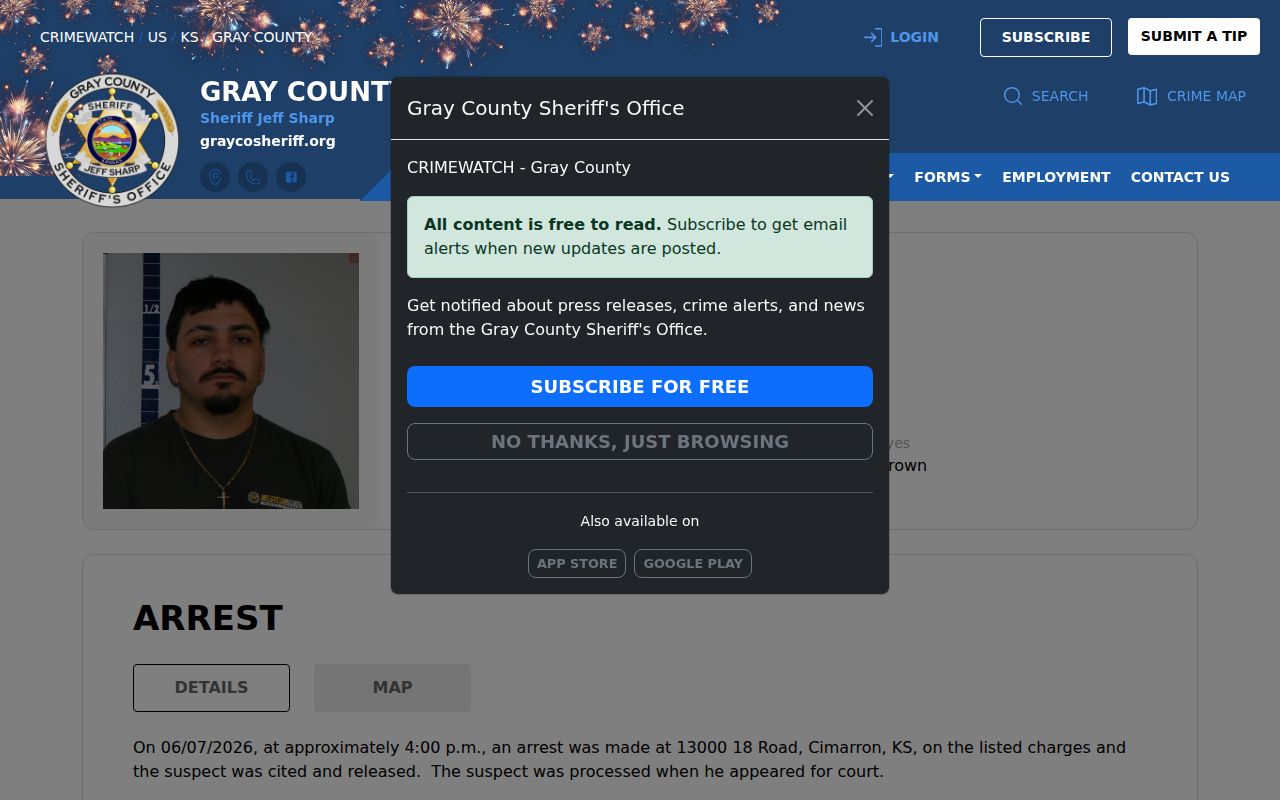
The narrative can support the stated citation outcome, while the image should remain labeled as an agency arrest-post photo unless the custodian confirms it is a booking photograph.
The platform's presumption-of-innocence warning should stay with any account of these posts. Charge text records an allegation. It is not proof of guilt or final disposition. For a durable outcome, pair the agency post with the Gray District Court case and the relevant host-jail record.
A precise label can be short. Use “Gray County Sheriff arrest-post photo” when that is all the source establishes. Use “Ford County jail booking photograph” only when Ford County identifies it that way. For a KASPER image, state that it is a KDOC offender photograph. These labels prevent one agency's picture from being attributed to another and preserve the difference between an arrest post, a jail intake, a corrections record, and a registry image.
Note: Source agency, image type, and capture date should remain attached to every Gray County released-inmate image reference.
Gray Federal Release Photo Limits
Federal custody follows a separate path. The BOP inmate locator can establish that a person left federal prison when it shows a past release date with no facility location, but it is not a public booking-photo gallery. A federal release result should therefore be used for status, not as a promise that a photograph exists. Gray County has no identified federal prison, and a local arrest does not become a BOP matter unless the person separately enters federal custody.
The U.S. Marshals Service prisoner photograph policy is more restrictive. It says agency personnel will not disclose federal-prisoner photographs, personal histories, or arrival and departure times to the public. A case-specific fugitive notice or official press release may still carry an image. Such a publication is an exception tied to that case, not a searchable archive of released federal prisoners.
The official policy is preserved in the federal prisoner-photo restriction capture.
The restriction explains why a federal status check and a federal image search must be treated as separate tasks.
When an official federal release or news item contains a photograph, retain the agency caption and date. Do not relabel it as a Gray County jail mugshot. If no public image exists, the correct conclusion is that no matching official image was found through the reviewed channel, not that the person was never photographed.
A court docket may identify the federal case and custody orders, but it usually serves as legal-event proof rather than an image source. Keep those roles distinct.