
Gray County Parole or Probation
Parole and probation both allow a person to live in the community under rules, but they begin in different ways. Kansas parole is a discretionary release approved by the Prisoner Review Board for an eligible person serving an indeterminate state sentence. Postrelease supervision follows the prison term for most determinate Kansas guidelines sentences. Conditional release is another state-law release point for some indeterminate sentences. All three remain under Kansas Department of Corrections authority.
Probation is usually ordered by a court instead of a prison term, or after a shorter local custody event. A person may post bond at the Gray County Sheriff’s Office and later receive probation from the court without ever becoming a KDOC prison release. The court’s sentencing order identifies the legal basis. Santa Fe Trail Community Corrections handles regional adult felony intensive supervision, while court services may handle other probation placements. A label must match the order and agency record.
| Supervision | How it begins | Primary confirmation |
|---|---|---|
| Parole | Prisoner Review Board authorizes release on an eligible indeterminate sentence | KASPER status, movement record, and assigned parole office |
| Postrelease supervision | Follows the prison term of most determinate guidelines sentences | KASPER and KDOC Parole Services |
| Conditional release | Statutory point tied to an indeterminate sentence and retained good time | KASPER and KDOC records |
| Probation | Gray County court order permits supervision in the community | Court docket, signed order, court services, or community corrections |
- Parole
- Discretionary community release from an eligible state-prison sentence.
- Probation
- A court-ordered community sentence supervised outside prison.
- Postrelease supervision
- A required supervision term after the prison part of many determinate sentences.
- Discharge
- The point when sentence duties are satisfied and KDOC authority ends.
Check Gray County Post-Release Supervision
The KASPER search is the first state channel for someone sentenced to Kansas corrections custody. It includes people in prison, under post-incarceration supervision, and discharged from sentences dating from 1980 forward. It is not a Gray County jail-release log. A person cited and released, released on bond, or placed on local probation may have no KASPER record.
- Search KASPER with the KDOC registration number when available. A name search should be checked against date of birth, photograph, conviction county, and case number.
- Read the current custody or supervision label. Parole, conditional release, and postrelease supervision show distinct forms of KDOC authority.
- Review facility movements and dates. Movement away from a prison plus a community-supervision status is stronger evidence than either field alone.
- Note the parole office shown in the record. Compare it with KDOC’s current county assignment table before contacting an office.
- For probation, review the Gray County court docket and signed sentencing order. Contact the named court-services or community-corrections program.
- Record release from confinement and final sentence discharge as separate events. A supervised person has left prison but has not yet completed the whole sentence.
KASPER updates daily except weekends. A recent weekend movement can lag. Its record may remain public after discharge unless the conviction is overturned, expunged, or executive clemency is granted. A missing result can also mean the person stayed only in county custody. The Gray County released inmate search explains the local records and host-jail paths for that separate event.
Gray County Parole Office
KDOC’s current parole office contact table assigns Gray County to the Garden City Parole Office in its South Region. The same regional assignment includes nearby counties such as Clark, Finney, Haskell, Meade, and Scott. Since office areas can change, check the live table before an in-person visit. Staff can help identify the correct reporting office or address a mismatch between a KASPER listing and the current assignment. Public details about one person may still be limited.
Garden City Parole Office816 N. Campus Drive, Suite 500
Garden City, KS 67846
Phone: 620-272-3879
The parole contact material also lists the Parole Services Automated Reporting System at 866-570-7225. That line is a reporting channel. It is not a general substitute for a KASPER search, the Garden City office, or the Sentence Computation Unit. Preserve the office name and observation date in a verification note because assignments and displayed statuses can change.
The manifest image below comes from the official KDOC parole-office table.
It supports the Garden City assignment, while KASPER remains the person-specific state supervision record.
Gray County Probation Supervision
Santa Fe Trail Community Corrections is the regional KDOC-funded intensive-supervision probation agency. It operates under oversight involving KDOC, Ford County, and an advisory board, and publishes a contact number of 620-227-4564. This is a useful route for an adult felony community-corrections placement tied to Gray County. It is not a jail roster, prison-release database, or parole office.
Begin with the Gray County court case. A register of actions may show sentencing, probation, revocation, a warrant, and a later discharge entry. The signed journal entry or probation order is stronger than a short portal label because it states what the judge ordered. If the order names Santa Fe Trail, contact that program. If it names court services, use the court’s listed channel. Probation is not proof that a host jail released the person on a certain date. Ford or Meade jail records may still be needed for the physical custody timeline.
A probation discharge order means the court ended that probation term. It does not automatically resolve a different KDOC sentence, another county case, or a federal hold. Keep each authority in its own line of the record.
Note: Santa Fe Trail Community Corrections identifies a regional supervision route, but the court order determines whether that route applies to one person.
Gray County Supervision Warrants
Conditions may come from a court, the Prisoner Review Board, or a parole officer. They can include regular and special rules. An alleged violation may lead to a warrant, an arrest, or a return to custody. An absconder is a person alleged to have stopped reporting or whose location is unknown to the supervising agency. That status is not the same as final discharge, and it does not erase the earlier release.
The Gray County Sheriff maintains a dedicated CRIMEWATCH warrants channel, but the reviewed page currently displays “No content found.” That statement only reports that no entries are posted in this web channel. It does not prove a named person has no Gray County, KDOC, court, or other warrant. Check the supervising agency and court record when status matters.
A sound timeline records the original release, type of supervision, alleged violation, warrant or revocation, return to custody, and later discharge as separate facts. If a person returns to a county jail, Kansas VINE may report that county custody change. VINE does not replace a parole or probation record and does not explain the legal basis for the alleged violation.
Gray County Post-Release Registry
The Gray County Sheriff handles court-ordered registration for qualifying sex, drug, and violent offenders by appointment. Its registered-offender page links both the Kansas Bureau of Investigation search and the OffenderWatch app. It also explains a local duty to report covered changes within 72 hours. Registration is a distinct legal duty. It is not a form of parole or probation by itself.
A registry match may help confirm that a qualifying registrant has a public community record. It cannot establish the prison or jail release date, release type, sentence discharge, or present custody. A person can be on a registry without being on active supervision. Likewise, the absence of a public match does not establish that a person was never booked or released. Compare multiple identifiers and follow the KBI accuracy warning.
The official Gray Sheriff source is shown in the assigned registry screenshot.
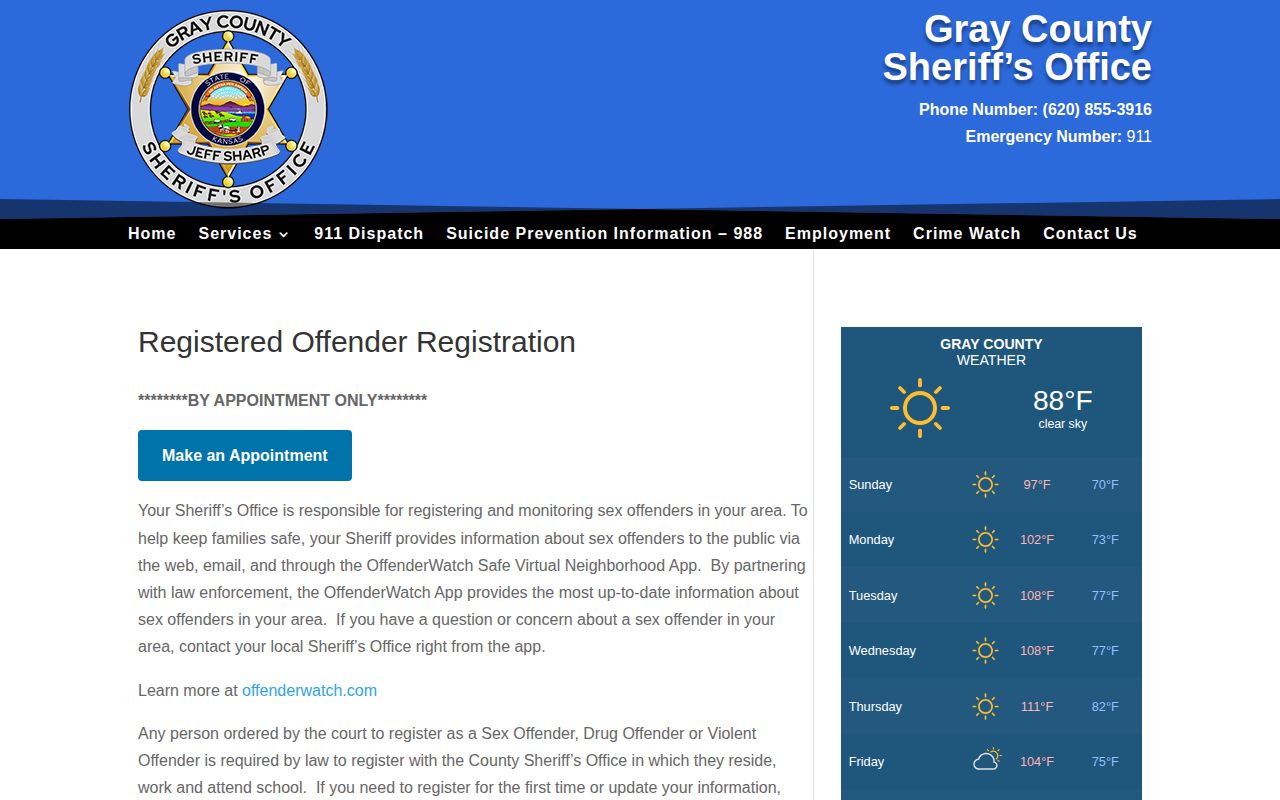
The image documents the local registration channel, not a release record or a broad list of supervised people.
Gray County Parole Hearing Signals
The Kansas Prisoner Review Board publishes monthly public-comment session notices and linked offender lists. A Gray County entry identifies the county of offense. KDOC warns that the conviction county is not necessarily the person’s home county or the place to which the person will return. Appearance on the list proves only that a parole-eligibility hearing is scheduled. It does not prove that parole was granted, a release plan was approved, or release from prison took place.
The Board can parole, continue, or pass an eligible case. A continue delays a final parole or pass decision for more information or review. A pass denies parole and sets a later reconsideration point. Even a parole outcome authorizes discretionary release but may still be followed by plan review or another condition. KDOC did not provide a public person-by-person decisions search in the reviewed sources, so check KASPER after its next update and contact the Board if the outcome remains unclear.
Most non-off-grid Kansas crimes committed on or after July 1, 1993 use determinate sentences and generally lead to postrelease supervision rather than parole eligibility. The calendar therefore covers a narrower group than all people approaching release. Do not treat it as a Gray County release list.
Gray County Supervision Discharge
Discharge is the endpoint of supervision. KDOC defines the sentence-discharge or maximum-sentence date as the date all duties on that sentence are satisfied and KDOC supervision ends. For a determinate sentence, good time earned during supervision may move the discharge date earlier. Awards are generally reviewed at six-month intervals under the KDOC supervision handbook. For an indeterminate sentence, the Prisoner Review Board may approve early discharge in an appropriate case, or the maximum term may control.
Do not substitute an anticipated release date for discharge. A parole grant, physical release from prison, placement at the Garden City office, and final KDOC discharge are four distinct milestones. For probation, seek the later court order that terminates or discharges the term. If a warrant or revocation appears later, the first release remains a historical fact, but it no longer describes current status.
Final confirmation should name the system, exact label, and date observed. KASPER supports the KDOC path. The court’s signed order supports probation. The listed office can resolve a current assignment, while host-jail records document any later physical detention.